A monoculture may look tidy, but it concentrates risk. Here’s how biodiverse gardens build healthier soil, support natural pest control, handle drought and excess water better, and create a more resilient garden ecosystem.
This page may contain affiliate links. Please read my disclosure for more info.
A tidy monoculture can look efficient: one crop, one clean edge, one obvious purpose.
But in the garden, neatness and resilience are not the same thing.
Whether it is a field planted with one crop or a garden bed filled edge-to-edge with the same vegetable, simplicity concentrates risk. A pest arrives and finds a buffet. A hard rain falls and the whole planting sits in the same wet soil. A hot, dry spell hits and the whole planting struggles. When everything in a space shares the same needs, the same timing, and the same vulnerabilities, stress tends to hit all at once, too.
A biodiverse garden works differently. It spreads risk across plant families, root depths, bloom times, growth habits, and microclimates.
Some plants shade the soil. Some pull nutrients from deeper layers. Some feed pollinators. Some shelter predators. Some help hold the ground in place during heavy rain. Others are better suited to the dry berm or the seasonally wet corner.
That is one of the reasons permaculture gardening resonates with me. It asks us to stop seeing the garden as a collection of individual plants with single benefits and start seeing it as a living community. The more relationships we build into that community, the more resilient it becomes.
Biodiversity builds relationships between plants, soil organisms, pollinators, and predators so the garden can bend instead of break.
In this article:
- Why Monocultures Fail Under Stress
- How Biodiverse Gardens Build Resilience
- 5 Ways to Build a More Biodiverse Garden
- The Goal Is a More Resilient Garden
Why Monocultures Fail Under Stress
Monoculture is not just for giant farm fields. It can also be applied to a small raised bed dominated by one crop, one root pattern, one bloom time, and one set of weaknesses.
When everything is the same, everything tends to respond the same way.
A single pest can spread quickly. A disease can move with ease. A weather swing can catch every plant at the same stage of growth. Even the soil feels the repetition, with the same nutrient demand being placed on the same patch over and over again.
A biodiverse planting softens those shocks.
Different roots occupy different layers of the soil. Different bloom times keep pollinators and predatory insects around for longer stretches of the season. Different plant heights create shade, airflow, and shelter. Different species respond differently to stress, so even if one planting suffers, the whole garden may still hold together.
I have seen this in my own garden. When my cherry trees were attacked by an uncommon pest, I first identified the pest, as well as its natural predators. Then I added companion plants that would attract those predators and improved the ecology under the trees with soil amendments and companion plants with a diversity of root structures.
Once the system became more diverse, the pest did not return.
That is the quiet strength of biodiversity. It does not promise that nothing will ever go wrong. It simply makes it less likely that one problem will take down the whole system.
How Biodiverse Gardens Build Resilience
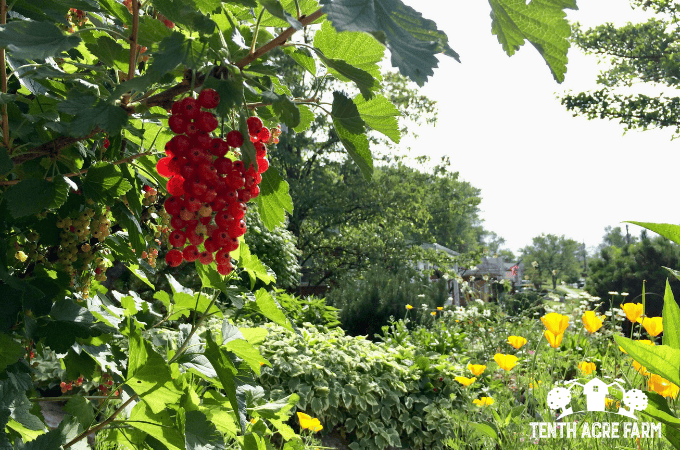
Red currants grow in a front yard garden with yellow California poppies.
Biodiverse Gardens Build Healthier Soil
Where there is biodiversity above ground, there is biodiversity below ground.
Different plants feed different soil organisms. Different roots create different channels for air and water. Different leaves and stems return different kinds of organic matter to the surface. Over time, all of that helps build richer, better-structured soil.
Combining plants, like chives and strawberries, is almost always a good idea—no recipe needed.
Healthier soil matters in every season. In dry weather, it holds moisture longer. In wet weather, it helps water move more gently through the ground rather than racing across the surface and carrying soil away. It becomes more sponge-like, which is exactly what you want when conditions swing from drought to downpour.
This is one reason I am so drawn to mixed plantings, living roots, and permanent beds. They do not just fill space. They help create the kind of soil that buffers extremes.
Biodiverse Gardens Support Natural Pest Control
A biodiverse garden is full of invitations.
Flowers provide nectar and pollen. Ground covers protect habitat near the soil surface. Shrubs and perennial edges offer shelter and undisturbed places for beneficial insects and other wildlife to live and hunt.
Instead of asking only, “How do I get rid of this pest?” biodiversity helps us ask, “What kind of ecology would keep this pest in better balance?”
That shift matters.
A biodiverse garden does not eliminate pests altogether. But it does make it harder for any one pest to dominate the whole space. It also gives us more reason to pause before reaching for (organic) sprays, because the goal becomes strengthening the whole ecology rather than managing each problem in isolation.
If you’d like more ideas for using plants to improve biodiversity and increase harvests, I share many of them in my award-winning book, The Suburban Micro-Farm.

Biodiverse Gardens Handle Drought and Excess Water Better
Garden resilience is often talked about in terms of drought, but biodiversity matters just as much when the problem is too much water.
In a simple planting, excess water tends to create a chain reaction. Bare soil is exposed to pounding rain. Water splashes soil onto leaves, crusts the surface, runs off quickly, or settles into one saturated zone where every plant struggles together. Oxygen leaves the soil. Roots slow down. Growth stalls. Disease gets an opening.
A biodiverse garden interrupts that pattern.
Ground covers soften the force of rain. Mixed root systems help open and stabilize the soil. Shrubs, perennial strips, and hedgerows slow runoff and spread water more gently through the landscape. Covered soil is less likely to erode or compact. Rich soil, full of organic matter and living biology, can absorb more water and release it more gradually.
Just as importantly, biodiversity allows us to match plants and strategies to the actual site.
Not every garden needs to hold more water. Some gardens need to shed it. In a poorly drained area, slowing water can make things worse. In that case, the answer may be reshaping beds, improving drainage, choosing crops that tolerate temporary wet feet, or using mulches and living covers in a way that allows excess moisture to escape rather than linger.
In other words, resilience is not just about adding biodiversity. It is about adding the right biodiversity for the conditions at hand.
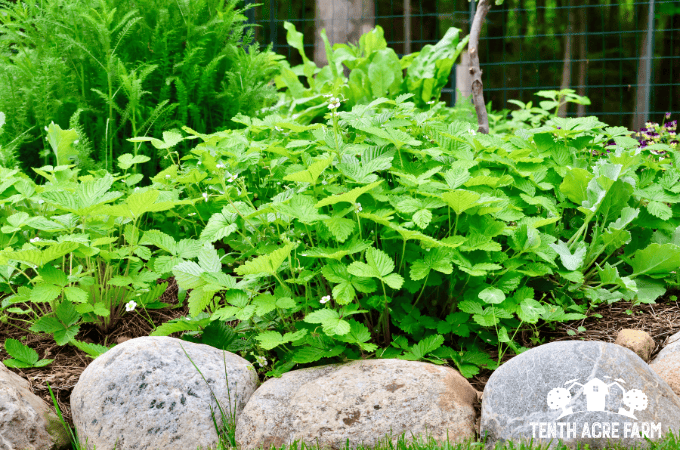
Alpine strawberries act as a ground cover and living mulch beneath a young plum tree, helping protect the soil and moderate moisture through both dry spells and heavy rains.
Biodiverse Gardens Create Helpful Microclimates
One of the loveliest things about a biodiverse garden is that it does not all feel the same.
Layered plantings create cool pockets, sunny edges, windbreaks, airy openings, damp corners, and sheltered understories. These microclimates allow more kinds of plants and more kinds of life to coexist in the same space.
A flower becomes more than a flower. A shrub becomes more than a shrub. A tree becomes shade, habitat, mulch, root structure, and weather protection all at once. One plant becomes mulch. Another becomes pollinator food. And still another becomes nesting habitat.
Biodiversity is not decoration. It is functional redundancy. When one element struggles, another is still working. That is one reason biodiverse gardens recover faster from stress.
5 Ways to Build a More Biodiverse Garden
1. Add flowers right into the vegetable bed
Instead of planting flowers only around the edges, tuck them among your crops.
This is not just a pretty-garden strategy.
In field-grown lettuce, a University of Warwick, England, study found that plots adjacent to wildflower strips had fewer aphids than plots without flowers, with the strongest reduction closest to the blooms. In another study at UC Berkeley, sweet alyssum significantly increased hoverfly egg production in lettuce fields, which led to more hoverfly larvae and fewer aphids.
A combination I especially like is Swiss chard with sweet alyssum. Their root structures are different enough that they do not compete heavily, and the alyssum helps shade the soil while creating habitat for beneficial insects.
It is a good reminder that beauty and function can live in the same planting.
Adding flowers is one of the simplest ways to make a vegetable bed feel more alive and functional. Flowers can help attract beneficial insects for natural pest control, extend bloom time throughout the season, cover soil, and add beauty to the space when integrated directly into the growing space rather than pushed to the sidelines.
Try planting broccoli with dill and nasturtium, or another simple trio of crop, flower, and ground-level support plant. Start small. The point is not perfection. It is connection.
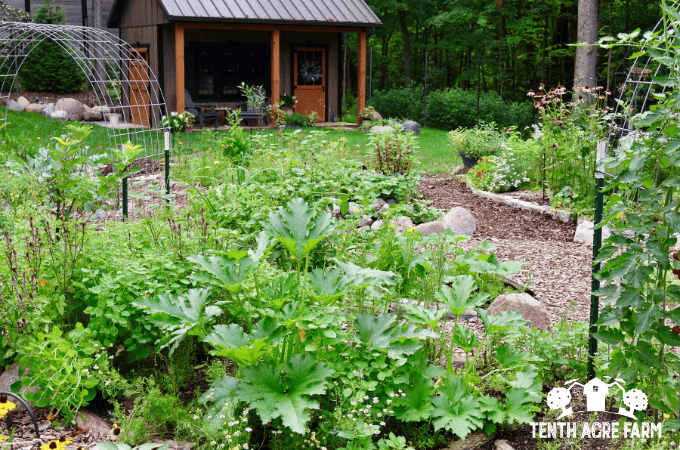
A zucchini plant in my garden is planted with chamomile, thyme, basil, and calendula in my garden.
2. Build one small fruit tree guild
You do not need a full food forest to start thinking in layers.
A single young fruit tree can become the center of a small planting community by adding a flowering companion to feed pollinators, a soil enricher with deep roots, a mulch plant with prolific growth, a shallow ground cover to protect ground habitat, perhaps an edible herb or native perennial.
Suddenly, the tree is not alone. It is supported.
Though flowering companion plants are beautiful, they also strengthen biological control.
A Washington State University study found that in apple orchards, trees planted with an understory of sweet alyssum had significantly lower woolly apple aphid densities after just one week.
Two Chinese university studies showed significant pest reduction when apple tree orchards were underplanted with mint, basil, and other aromatic plants; and when pear tree orchards were underplanted with catnip, basil, and other aromatic plants.
Borage is a strong companion because it feeds pollinators, shelters beneficial insects, produces mulch, has edible flowers, and fits beautifully into a guild.
Prairie clover (Dalea spp.) is another useful companion, especially if you want a native plant that makes a pleasant tea, has wide ecological appeal to bees, butterflies, and birds, and enriches soil as a nitrogen-fixer. Comfrey and yarrow also have useful roles depending on your site, goals, and region.
The best fruit tree guilds are not copied formulas. They are living relationships built on observation.
This way of thinking changes everything. It trains the eye to ask a better question: what else belongs here?
3. Plant a mini hedgerow or perennial backbone
Even a small strip of mixed perennials can do a surprising amount of work. Intentional micro-hedgerows can harbor significantly fewer crop pests and more beneficial insects than a weedy edge, a sterile lawn edge, or a conventionally landscaped border.
A line of shrubs, flowers, and long-lived plants along a fence or property edge can reduce wind, slow runoff, protect soil, support birds and insects, and stitch the garden together into a more stable ecology. It can also make the garden feel rooted and mature, even when the annual beds change from season to season.
Consider a living edge of currant bushes, elderberry shrubs, coneflowers, bee balm or other useful species. This kind of “perennial backbone” is the quiet structure that keeps showing up, year after year, doing ecological work in the background.
4. Include at least some bioregional natives
A biodiverse garden does not need to be natives-only to be ecologically richer. But including some plants that evolved with your local insects and birds can strengthen the food web in ways purely ornamental plantings or annual crops often do not.
Native shrubs, flowering perennials, and trees can all help restore missing relationships in the garden. University of Delaware research found that residential yards needed more than 70% native plant biomass to sustain local Carolina chickadee populations.
You may not be aiming for a precise percentage, but the principle is useful: even partial shifts toward bioregional natives can bring in a wider cast of insects, which in turn support more birds and a healthier garden ecology.
You do not need to overhaul everything at once. Add a native shrub such as aronia berry, a native flowering plant such as perennial sunflower, or a native tree such as American plum to an existing bed. If you want to add more native edibles, you can browse native berry bushes at Food Forest Nursery.
Biodiversity tends to grow by layering, not by all-at-once replacement.
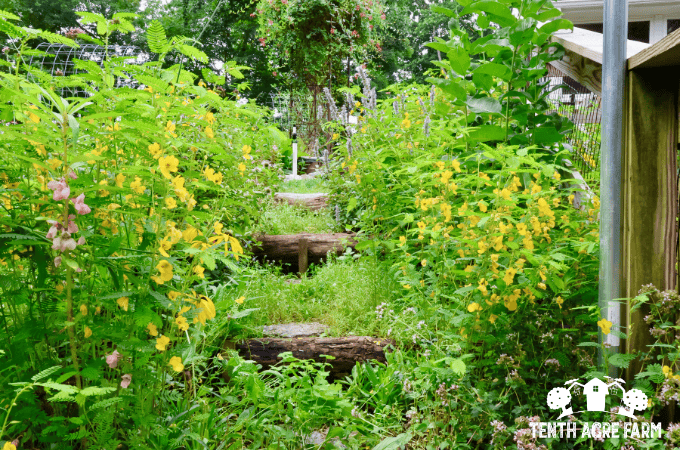
Native plants like yellow-flowering partridge pea, anise hyssop, and milkweed occupy this terraced bed in my garden, which harbors beneficial garden snakes, amphibians, birds, bees, and butterflies.
5. Protect the soil
Bare soil is vulnerable soil. It dries out faster in drought, erodes faster in storms, and supports less life overall.
A biodiverse garden protects soil with mulches like leaf litter, wood chips, or compost, as well as with diverse root systems, and less disturbance, which helps moderate soil temperature, reduce erosion and compaction, improve water retention, and protect habitat during dry periods.
This matters in wet weather just as much as in dry weather. Covered soil is less likely to crust, compact, or wash away.
Meanwhile, diverse, living roots help maintain structure and biodiversity below ground. In one study, greater plant diversity increased soil bacterial and fungal biomass.
Undisturbed soil, a key concept in no-till gardening, also protects the many creatures working quietly there, including the ones that help with pest control. For example, firefly larvae, which are slug-eating predators, require undisturbed ground and leaf litter to thrive. They are endangered because so much of the soil today is unprotected and disturbed.
In practical terms, the more often you can keep roots in the ground and the soil covered, the more resilient the whole garden system becomes.
The Goal Is a More Resilient Garden
A resilient garden does not have to be huge, wild, or fully finished. It does not have to look like a finished food forest. It simply needs more relationships built into it.
That may look like flowers in the vegetable bed. A fruit tree with companions. A living edge along the fence. A few natives tucked into an existing border. A low spot planted more thoughtfully. A wet corner no longer forced to act like a dry one. A patch of soil finally kept covered.
When we stop asking only, “What can I grow here?” and start asking, “What kind of living community can I build here?” the garden begins to change.
A flower becomes insect habitat. A ground cover becomes erosion control. A perennial root becomes drought insurance. A hedgerow becomes flood protection. A guild becomes pest prevention. A mixed planting becomes a garden that is more forgiving, more stable, and more likely to keep feeding both people and wildlife when conditions are less than ideal.
That is why biodiverse gardens survive what monocultures often cannot: they are not relying on one answer.
How are you adding biodiversity to your garden?
Read next:
- 6 Flowers to Grow in the Vegetable Garden
- How to Build a Permaculture Fruit Tree Guild
- How to Plant a Hedgerow


Leave a Reply